Yes! According to the Executive Order, “Individuals whose residences are unsafe or become unsafe, such as victims of domestic violence, are permitted and urged to leave their home and stay at a safe alternative location.”
A domestic violence protective order is a civil order in which one party goes to the court ex parte (without the other party present) and explains why they are substantially frightened or feel harassed by an opposing party.
50B
A 50B is for parties that have a domestic relationship (former spouses, parents, and children, or have otherwise lived in the same house.)
50C
A 50C is for people who have never resided together (colleagues, friends, relatives that don’t live together.)
If and when an ex parte order is granted, it requires the accused to have no contact with the other person, not via text, phone, social media, or through a third party. If a 50B or 50C is violated, it could very well lead to criminal charges, even though they are civil orders.
Court Hearing
After the orders are entered into, there will be a hearing in about ten days so the accused can present evidence to refute the claims of the other party and state why the order shouldn’t have been granted. This evidence may include texts, medical records, arrest records, witness testimony, and maybe even videos. The court will make a final decision at that point as to whether the order will remain in place or not.
Domestic violence can have a huge impact on your life, including custody of your child. If a protective order is granted the court can give temporary child custody to the party bringing the accusations. You can file a custody lawsuit for a judge to decide what the best interest of the child is. It’s important to move quickly to protect your rights as a parent. If you are subject to a domestic violence protective order and have questions about your custodial rights, please give one of our family law attorneys at McMinn, Fradin, Gray & Logan a call.
There are, generally speaking, three different types of bonds that you might be given when you are charged with a criminal offense. The one given the most often to people with no criminal history who are charged with a minor infraction is called a written promise to appear. Essentially, it is a written statement saying you will come to court on a proper day and at the proper time. If you fail to do so, the court will issue a failure to appear, bring you into court, and likely issue you a new bond.
The second type of bond is an unsecured bond. The Magistrate or Judge will issue you a dollar amount, which you will not owe unless you fail to come to court. So, with both of these types of bonds, if you show up in court, you don’t pay anything.
The third type of bond, a secured bond, is usually reserved for serious offenses or those with a history of not coming to court. In this case, you must pay your bond upfront but will be repaid the bond amount upon completion of all court appearances.
North Carolina has a zero-tolerance policy when it comes to driving and underage consumption of alcohol. This means that even if a person under the age of 21 has a .01 blood alcohol level, they can and will get a DUI or be charged with driving after consuming underage. They are facing the same consequences as a DWI, a loss of license, possible jail time, and a non-expungable criminal record. Fortunately, there are deferred dismissal programs, conditional discharge, and a prayer for judgment continued which might help lessen the consequences to the person’s driving license and criminal record.
Criminal Defense Attorney Clarke Dummit explains the consequences of a DWI.
For a first offense, most people will face a misdemeanor conviction, a 30 to 60-day suspended jail sentence, limited driving privileges for a year, 24 to 48 hours of community service, and somewhere between $300 and $800 in court costs and fines. If there are any aggravating factors, like children in the car, the sentencing will become harsher, but for a first offense with no aggravating factors, this is the most likely scenario.
A second offense within a short period, less than a year, is likely going to be an aggravated level one, or A-1, which is a mandatory one-year prison time. If the second offense is after one year of the first conviction you could be facing vehicle forfeiture and no driving privileges. If the second offense is after three years of the first conviction, then there may be up to a four-year license suspension. A second conviction after seven years drops down to a level 2 and your license is only suspended for one year. So, while the conviction stays on your record forever, the penalties for a second conviction lessen over time.
Criminal Defense Attorney Anastasia Tramontozzi explains that while not all assault on female cases occurs in domestic settings, for the purposes of owning firearms, these are all treated as such by federal law. The two parties don’t even have to know each other. The only requirements are, the accused must be a male 18 or older and the accuser must be a female. If he is found guilty or pleads guilty, he loses his Constitutional right to possess a firearm. So, while assault on a female cases may not be domestic cases technically, the law considers them domestic cases and the consequences are as severe.
Criminal Defense Attorney Tyler Chriscoe explains when you can and can’t leave the scene of a crime.
Crashes Are Scary
Crashes are scary. But North Carolina law is clear. If you are involved in a crash there are three things you have to do.
Stop the Vehicle
Remain with the Vehicle
Do not move the Vehicle unless authorized to do so
If you are in a crash, it is a crime to drive away, walk away, or even move the vehicle. Punishments for hit-and-runs can be severe and like most crimes, it depends on the severity of what happened.
When Can I Leave an Accident?
There are some times when you can leave the scene of an accident. Some examples would be,
If you staying on the scene puts yourself or somebody else at risk of injury.
If you need medical attention.
Any time an officer allows you to leave the scene.
When Can I Not Leave an Accident?
There are some reasons why you should not leave an accident.
Being scared or anxious.
Not knowing what to do.
Having to be somewhere else by a certain time.
Law enforcement is going to be the one to decide when you can and can not leave.
Can I Leave a Small Fender Bender in a Parking Lot?
If there is no injury and you think the property damage will be less than $1,000, the parties involved in the accident can agree to exchange information without involving law enforcement. But, keep in mind that property damage can easily be more than $1,000.
Contact Us
Hopefully, this message reaches you before you are involved in a car crash and you’ll know what to do. But, if it’s reaching you too late and you’ve already been charged with hit and run, the best thing that you can do is to call an experienced criminal defense attorney. McMinn, Fradin, Gray & Logan has been helping people charged with crimes for over 30 years. So if you’ve had a hit-and-run, give McMinn, Fradin, Gray & Logan a call today. If you have been charged with a hit and run contact us to discuss your options.
Criminal Defense Attorney Anastasia Tramontozzi explains that while you can file for an expungement yourself, it isn’t a very good idea. Filing for expungement is a complicated process involving obtaining original notarized documentation, serving the proper people, and calendaring your case to go before a judge. If you were actually convicted of the crime, the process is even more complex. Therefore, it’s a good idea to allow an attorney to help. Give one of our attorneys a call.
Attorney Clarke Dummit provides insights into ignition interlock devices. If the device detects interference or alcohol, it records the information on its microchip. Every two months, the device needs to be downloaded by an interlock provider, and the data is transmitted to the North Carolina Division of Motor Vehicles (NCDMV). The DMV can typically take months to respond and sends a form letter notifying the driver of license revocation, allowing for a hearing if requested within 10 days. It is crucial to maintain an updated address with the DMV to receive these notifications and to contact an attorney promptly upon receiving a revocation letter.
If the interlock device registers a positive reading, it is recommended to stay with the vehicle. False positives can sometimes occur due to various factors, such as consuming certain foods or experiencing interference during the breath test. If a positive reading occurs, the driver should not give up, leave the vehicle, or go to work. Instead, they should remain with the vehicle and attempt to start it again after a five-minute lockout period. If another positive reading occurs, the lockout period may increase to 45 minutes. It is important to stay with the vehicle and continue blowing into the device to demonstrate that there was no alcohol.
However, if alcohol is present on the breath, there is no way to erase the device’s record, and it will be reported to the DMV. In such cases, the driver may face consequences. On the other hand, many clients claim that positive readings were due to interference or extremely low alcohol levels. Ignition interlock devices are safety devices rather than precise measuring instruments, and their calibrations may not be highly accurate. Because of this, it is advisable to stay with the vehicle, blow until obtaining zero readings, and seek the assistance of a traffic attorney due to the potential inaccuracies of the machines.
Criminal Defense Attorney Anastasia Tramontozzi discusses who can see expunged charges, and who cannot. Once you’ve had a charge expunged, you can legally say you’ve never been charged with that crime. Schools, most employers, and private citizens will not be able to find the charges after a few months to a year. However, there are certain agencies like DAs and police academies that can still see the history. Because of the time it takes to purge the systems, we recommend beginning the process early and having an experienced attorney at your side to ensure it’s done properly.
Criminal Defense Attorney Clarke Dummit explains the 3 types of revocations that could affect your license if you are charged with a DWI in North Carolina as well as interlock devices.
What kind of revocations am I facing with a DWI?
There is a civil revocation that is imposed by the magistrate and lasts for 30 days. It is non-criminal and will happen if you blow over a 0.08 on a breathalyzer or if you refuse to take one. In the event of a civil revocation, you have 5 days to turn in your license and can then petition the court 10 days later for limited driving privileges. If you do not turn in your license, however, your revocation is extended to 45 days. Also, if you refuse a breath or blood test, there is an administrative revocation imposed by the DMV which lasts for a year. You only have 10 days to ask for a hearing if your license has been administratively suspended by the DMV due to your refusal to submit. You may ask for limited driving privileges after 6 months in this case provided you haven’t refused a test in the last 7 years, the DWI is settled, and any necessary alcohol classes are complete. And if you are convicted, the judge can revoke your license on a criminal basis. This could be anywhere from 1 year to permanent depending on your record. These revocations can overlap or not.
How will my prior DWI record affect my driving privileges this time?
If this is your first DWI, you are only facing a 1-year revocation and can likely get limited driving privileges within that time. If you have a prior DWI conviction within the last 3 years, you are facing a four-year revocation but may be able to get a conditional restoration hearing at the DMV after 2. If you have 2 prior convictions within the last 7 years, you are looking at a permanent revocation of your license, which simply means you need to go to a conditional restoration hearing to have your license restored.
What are the ways to get an interlock device requirement?
If you obtain conditional restoration of your license after habitual DWIs, you likely will have an interlock device on your vehicle for 2 to 7 years. There are different ways to have this restriction, if you blew a 0.15 or above on your breath test, you are under an alcohol content restriction or you have conditional restoration of your license. If you happen to get an Interlock violation, you only have 10 days to respond, and depending on why you have the restriction, the administrative details are different. So, it is critical to know why you have the restriction in the first place.
When can I drive with limited driving privileges?
Limited driving privileges can vary a great deal. There are 2 types, standard and non-standard. Standard hours are 6 A.M. – 8 P.M. Monday – Friday and non-standard hours are after 8 P.M. and on weekends. To obtain non-standard hours, you need a letter from your job and we have to draft something for the judge stating why you need to drive outside of standard hours. However, standard hours can be used for travel to and from work or maintenance of the household.
There are two reasons why someone might be required to have an ignition interlock:
an alcohol content restriction
a conditional restoration.
Driving a vehicle without an ignition interlock when it is required can have serious consequences. One consequence is being charged with driving while license revoked by a law enforcement officer. This can lead to the termination of any conditional restoration and alcohol content restriction, ultimately revoking the license. If someone is under a conditional restoration and drives without an ignition interlock, it can revert them back to a state of permanent revocation, with a prolonged period before being considered for conditional restoration again. It is crucial to adhere to the requirement of having an ignition interlock if it has been imposed as a restriction.
Driving with a revoked license is a class one misdemeanor in North Carolina. Even for a first-time offense, you could be facing up to 45 days of supervised probation. Multiple moving violations with a revoked license carry even stiffer penalties including a longer wait to get your license back or losing it permanently. However, “permanent” doesn’t mean forever! It simply means you have to schedule a hearing in front of a DMV Officer and your license will probably be subject to conditions before it will be restored fully. At McMinn, Fradin, Gray & Logan, we can help. Give one of our experienced Traffic Defense Attorneys a call before you try and take on this complicated process by yourself.
A respected family law attorney explains the importance of a proactive approach in handling a domestic violence protective order (commonly known as a 50B). 50bs are civil orders with criminal consequences, as such, if one is issued against you it can have a significant effect on your life. Child custody, employment, professional licensure, and the ability to own a firearm are all affected. With only a 10-day window to present your side to the judge, you will need to act fast to gather evidence and prepare a full trial to counter false allegations and ensure a fair hearing. Contact us today to schedule a consultation if you are facing a DVPO.
A DWI dismissal is highly unlikely since a District Attorney would have to file paperwork with the court so that it becomes a matter of public record. Many organizations, like Mothers Against Drunk Driving, watch for these records and make problems for the District Attorneys. So, they rarely simply dismiss a DWI charge. Usually, the matter goes before a judge where there is a move for a dismissal based on suppression or constitutional grounds. Or sometimes, a not guilty plea is entered and there is a trial.
In every DWI case, there is a warrantless arrest. The Fourth Amendment protects you from unreasonable search and seizure, but since a traffic stop isn’t a strenuous hold, the standard is low. However, the arrest is serious, therefore we must make sure they have collected enough evidence in the field to uphold that arrest. So, we need to look at both whether they had reasonable cause to stop you and reasonable cause to arrest you.
Next is the scientific evidence. This is fairly complex, and the state must be able to get this into the trial.
The third complication is the special sentencing factor which is different than any other crime in North Carolina. So, as you can see, DWIs are very complicated.
Avery Crump is the District Attorney, or DA, for Greensboro, North Carolina. She works with at least four Assistant District Attorneys to prosecute all criminal cases filed in the 24th District. Additionally, she prepares the docket and advises law enforcement. Attorney Crump and her Assistants are responsible for plea bargains or reductions and make sentencing recommendations to the presiding judges. Therefore, when you are charged with a crime, you should retain representation familiar with the DA in the district. You need an attorney with a reputation for integrity who regularly negotiates with the person prosecuting you. The Criminal Defense Lawyers of McMinn, Fradin, Gray & Logan in Greensboro, NC, have that reputation and know the District Attorney and her Assistants well.
Court costs, probation costs, and other fines associated with DWI’s in Greensboro can be paid at the Clerk’s Office in the Payments and Receipting department on Floor UG of the Guilford County Courthouse located at 201 S. Eugene Street in Greensboro, NC 27401.
The Community Service and Probation office is located on the 3rd floor of the Guilford County Courthouse located at 201 S. Eugene Street in Greensboro, NC 27401.
Criminal Defense Attorney Anastasia Tramontozzi explains the timing of North Carolina expungements in this video. You can have any not guilty or dismissed charge expunged the very same day. However, even if you are convicted of a crime, you may still be eligible for an expungement after a waiting period depending on the charge. A misdemeanor typically requires a 5 to 7-year waiting period while a felony requires a 10-year wait, and both require that no new charges arise during that time. And some charges, like murder, can never be expunged. If you have questions or are ready to clean up your record, give one of our Criminal Defense Attorneys a call today.
For a first offense, most people will face:
a misdemeanor conviction,
a 30 to 60-day suspended jail sentence,
limited driving privileges for a year,
24 to 48 hours of community service, and
somewhere between $300 and $800 in court costs and fines.
If there are any aggravating factors, like children in the car, the sentencing will become harsher, but for a first offense with no aggravating factors, this is the most likely scenario.
If a second offense occurs withina year, most people will be sentenced to an aggravated level one, or A-1 (which is a mandatory one-year prison time)
If a second offense occurs after one year of the first conviction, they could face vehicle forfeiture and no driving privileges.
If a second offense is after three years of the first conviction, then there may be up to a four-year license suspension.
A second conviction after seven years drops down to a level 2, and their license will likely only be suspended for one year.
So, while a conviction stays on a criminal record forever, the penalties for a second conviction lessen over time.
When stopped, and before you are taken to the testing room downtown:
Remain polite,
Avoid making any incriminating statements,
Request an attorney as early in the process as possible.
Unfortunately, most individuals cooperate with law enforcement. They take field sobriety tests and provide statements. These actions are voluntary and recorded by body cameras. It’s important to note that they rarely present the accused in a favorable light, which can have serious and negative repercussions in court.
There is a constitutional right not to incriminate oneself, which applies even when stopped for a DWI. However, this right is waived once the individual enters the breath testing room. Implied consent applies to the breathalyzer test administered in the breath room—not the initial tests conducted on-site. The DMV will administratively suspend the driver’s license of someone who refuses a breathalyzer in the breath room for one year in addition to any criminal consequences stemming from the DWI.
So, should you take the breathalyzer? If you are confident that you are under the legal limit, the answer is yes. However, if you believe you are over the limit, you should consider whether you possess a valid driver’s license and whether you have previous DWI convictions. Additionally, it’s crucial to remember that law enforcement can obtain a search warrant for a blood test, which you cannot refuse. If they do obtain a search warrant, not only would this lead to administrative revocation of your license because of your refusal, but you would still have to contend with the evidence gathered against you in court.
A bond is a monetary guarantee from you given to the State to ensure that you will show up to your court proceedings. Once you have shown up to all your court proceedings, your bond is returned. Should you decide to do so, you can pay any court costs or fees out of your bond before repaying it to you. However, if you do not show up to your court proceedings, your bond could be forfeited and distributed to various State agencies. So, it is essential that if you have a bond, you show up to court and take care of your affairs.
Facing a warrant for missing court can be terrifying, but it’s not always as serious as it seems. The consequences depend on the specific charges. If you missed a court date, there are three potential outcomes: called and failed, failure to appear, or an order for arrest. A called and failed case is usually for minor offenses like traffic tickets and can often be easily rescheduled. However, if left unresolved, it could lead to a license suspension. A failure to appear is more serious and requires a document from the district attorney to reschedule. An order for arrest is the most severe, potentially leading to jail time. If you find yourself in this situation, give one of our Criminal Defense Attorneys at McMinn, Fradin, Gray & Logan a call and set up a consultation!
What You Need to Know About Secured Bonds and Bondsmen
If you or a loved one has received a letter from a bondsman about a secured bond, you might be wondering what it all means. Let’s break it down.
A secured bond is a type of bail where you must pay cash to the state before being released on your own recognizance, prior to your court proceedings. For example, if a magistrate judge sets a $10,000 secured bond, you’d typically need to pay that full amount upfront. The good news? If you attend all your court dates and handle everything properly, you get that $10,000 back when the case ends.
But what if you don’t have $10,000 lying around? That’s where a bondsman comes in. A bondsman offers a solution by charging you a fee—usually around 10% of the bond amount. So, for a $10,000 bond, you’d pay the bondsman $1,000. In return, they put up the full $10,000 to the state on your behalf. The catch? That $1,000 is theirs to keep, even if your case resolves successfully.
This can be a huge advantage, especially for larger bonds like $250,000. Very few people have that kind of cash readily available, and the ability to secure your release before trial is critical. Statistics show a staggering difference in criminal defense outcomes between those who get pretrial release and those who don’t—making a bondsman an important part of the justice system.
So, if you’re facing a secured bond and need help navigating your options, consider reaching out to a trusted resource like McMinn, Fradin, Gray & Logan. Your pretrial release could make all the difference.
Criminal Defense Attorney Anastasia Tramontozzi describes what types of charges cannot be expunged. For instance, murder is never expugnable. But neither are certain misdemeanors like DWIs, DUIs, or assaults unless you were under the age of 18 when charged, then they may be. Expungement law is complex. If you have questions about eligibility or are ready to try and clean up your record, contact one of our experienced Criminal Defense Attorneys today!
In North Carolina, insurance companies are required to act reasonably when handling claims. They must promptly investigate claims, pay valid claims, and refrain from fraudulent misrepresentations or bullying tactics. If an insurance company acts in bad faith by delaying payment, wrongfully denying a claim, or lying to the policyholder, the plaintiff may be entitled to treble damages, which means they can receive three times the compensation for their damages. For instance, if a person’s car is totaled in an accident and the insurance company wrongfully denies the claim, forcing the individual to purchase a new vehicle out of pocket, the insurance company could be compelled to pay three times the cost of the replacement vehicle. If you believe your insurance company has acted in bad faith, you can seek assistance in pursuing a bad faith insurance claim. Contact us to find out more about your claim.
Criminal Defense Attorney Anastasia Tramontozzi talks about how the recent rise in catalytic converter thefts in North Carolina has led to a rise in other violations as well. Many of our clients have been innocent of the obvious crime of possessing stolen property, but have been charged with violating policies and procedures when it comes to buying and selling used catalytic converters. In some circumstances, even if you unknowingly possessed a stolen catalytic converter, you could still be charged with a felony and be facing active jail time. So, if you have charges stemming from catalytic converter theft, give one of our Criminal Defense Attorneys a call. We can help.
Imagine this: the state demands you surrender your firearms, but you haven’t even had your day in court. It’s a tough spot to be in, and it happens more often than you might think. If you’re facing a 50B civil domestic violence restraining order or a 50C criminal violence restraining order, the law requires you to turn over your guns before any court proceeding resolves your case. But what happens if you’re found not guilty? How do you get your firearms back? Spoiler alert: it’s not a walk in the park. Let’s break it down.
Why Your Firearms Were Taken
Under these two legal mechanisms—50B and 50C—the state doesn’t wait for a conviction. If you’ve been charged in a domestic or criminal violence case, you’ll need to hand over your firearms right away. It’s a preemptive move by the courts, and it applies whether you’re guilty or not. The good news? If you’re cleared of the charges, there’s a path to reclaiming what’s yours. The bad news? It’s a complicated one.
The Process to Get Your Guns Back
So, you’ve been found not guilty—congratulations! Now, how do you retrieve your firearms? Buckle up, because it’s a multi-step ordeal:
File a Petition: Your first move is to head to the clerk of court and file a petition to have your firearms returned. This kicks off the process, but it’s just the beginning.
Serving the Papers: Once your petition is filed, the clerk will serve two key parties: the alleged victim in your case and your county sheriff’s department. They both get a say in what happens next.
Background Check: The sheriff’s department takes over from there, running a thorough background check on you. They’re looking for any reason—past or present—that might disqualify you from owning firearms.
The Victim’s Testimony: The alleged victim will have a chance to testify. Their input could sway the outcome, so this step carries weight.
The Judge’s Call: Finally, a judge steps in. They’ll review everything—the sheriff’s background check, the victim’s testimony, and any other evidence provided. Based on this, they’ll decide if you’re eligible to get your guns back. Here’s the kicker: even if you’ve been found not guilty, the judge can still say no. That’s right—it’s their discretion, and their ruling is final.
Why You Need Help
This process isn’t just long—it’s tricky. One misstep and you could be left empty-handed, even if the law says you’re entitled to your firearms. That’s why, if you find yourself in this situation, hiring an attorney isn’t just a good idea—it’s essential. A skilled criminal lawyer can navigate the paperwork, advocate for you in court, and help tip the scales in your favor. Don’t go it alone—get legal help and fight for what’s yours. Contact us today!
Criminal Defense Attorney Clarke Dummit answers 3 of the most commonly asked questions his clients are concerned about after they have been charged with a DWI in North Carolina.
Is it a felony?
Generally, in North Carolina, a DWI is charged as a misdemeanor. However, if you’re driving while impaired charge involved death or serious injury to another you could be dealing with a felony charge as well. Further, if you’ve accumulated three DWI charges within a 10-year period, you could be facing a habitual DWI charge, which is a felony. So, it depends on the specifics of your case, but more than likely, you’re DWI is a misdemeanor charge.
Am I going to jail?
Jail time is heavily regulated by statute in our state. The judge must consider many things which may lower or raise your sentence, and grossly aggravating factors that jump you to mandatory jail time. However, even if the statutes do call for mandatory active jail time, we have sentencing alternatives that many judges will consider.
When can I drive again?
This is, again, dependent upon the specifics of your case. There are 3 different means and durations for license revocation in North Carolina, all of which begin and end at different times:
A non-criminal civil revocation is done by the magistrate and lasts for 30 days
Refusing a breathalyzer will cause the DMV to revoke a license for up to a year under an administrative revocation
When convicted of a DWI the judge will revoke a license on a criminal revocation.
For more information see our limited driving page
No. When you simply pay off a speeding ticket, you lose the opportunity to plea and reduce the ticket. Reducing a ticket is imperative since it can not only cause insurance costs to rise, but it can also impact your ability to drive. For instance, if your ticket is for over 55mph and for 15mph or more over the posted speed limit, your license can be suspended. Further, if you accumulate twelve points on your license in three years, you can also have your license suspended. However, the consequences for commercial drivers are harsher, they can lose their licenses permanently. So, it’s never a good idea to simply pay a speeding ticket, call one of our experienced Traffic Attorneys whenever you get a speeding ticket and let us help.
Criminal Defense Attorney Anastasia Tramontozzi announces changes that went into effect in December 2020 relating to expungements and who is eligible. Those who have had cases dismissed or have been found not guilty, even felons, are now eligible for expungements. Additionally, those who committed offenses under the age of 18 are now eligible to have more charges expunged. If you or someone you know would like a criminal charge expunged, contact one of our Criminal Attorneys today!
The Criminal Defense Team of McMinn, Fradin, Gray & Logan explains exactly what a Prayer for Judgement is and why it may or may not be right for your situation. A PJC can only be granted after a guilty plea has been entered, this means the conviction will remain on your record. You may be protected from negative sentencing, but you might also limit your ability to appeal or extend the time required before you can get an expungement. However, every case is different. If you are facing charges and considering a Prayer for Judgement Continued, you should contact one of our Defense Attorneys and set up a consultation today!
If you are not a resident of North Carolina for the entire year while having an ignition interlock requirement, it can be challenging to have the interlock results recorded and sent to the North Carolina DMV. This often leads to complications when individuals who hold a valid driver’s license from another state receive an ignition interlock DWI in North Carolina. According to the current opinion from the attorney general’s office, if you are licensed in another state and reside outside of North Carolina, you can legally drive through North Carolina without completing an ignition interlock. However, if you reside in North Carolina and have not fulfilled the ignition interlock requirement, driving would be considered driving while your license is revoked. Therefore, it is crucial to consult a DWI attorney if you have an ignition interlock and an out-of-state license.
Yes, a violation of this Executive Order may be subject to prosecution and is punishable as a Class 2 misdemeanor. If you’re charged with a misdemeanor, we recommend that you speak with an attorney about your rights as soon as possible.
An award-winning Criminal Defense Attorney goes in-depth to explain your Constitutional rights when you’re pulled over by the police. You should always be polite and respectful to law enforcement, however, you shouldn’t say anything incriminating about yourself, and you do not have to give your consent to a search of your vehicle. If you have been charged with a traffic violation or have a more serious criminal charge, give one of our Criminal Defense Attorneys a call. You have the right to the best defense possible, so always ask for an attorney!
According to Criminal Defense and Traffic Attorney Tyler Chriscoe, a commonly asked question is “what happens if I have a small fender bender in a parking lot?” If there are no injuries and the property damage appears to be less than $1,000, the two parties can agree to exchange insurance information and be on their way. But keep in mind property damage can easily exceed $1,000, sometimes just to fix paint damage.
Hopefully, you will exchange information but if you are watching this video too late and you are possibly facing a hit and run, the best thing to do is get an experienced criminal law defense attorney on your side. If you need help contact us to discuss your options.
An ignition interlock device is a safety device, it is not a measurement device. So it cannot tell the difference between alcohol that is found in medicine versus alcohol found in beer and wine. Attorney Clarke Dummit has extensive experience with ignition interlocks and their role within the NC court system and NC DMV. In this video, he explains how your medication may cause you to fail an ignition interlock test and what your options are in this situation.
An exceptional Criminal Defense Attorney discusses the three standard types of field sobriety tests that law enforcement uses and why they aren’t reliable to test for marijuana. They include the horizontal gaze nystagmus test, the walk and turn, and the one-leg stand. In the first test, the twitching that is present in your peripheral vision is always present in the case of alcohol impairment but doesn’t apply to marijuana. Further, testing for balance and stability, like in the second and third tests, isn’t reliable for marijuana either. If you’ve been charged with a DWI due to marijuana impairment, make sure your attorney is well-versed in the science.
The Risks of Leaving Your Car Running With an Ignition Interlock Device
[00:00:00] If you are required to have an ignition interlock device (IID) installed in your vehicle, you might wonder about the practicalities of using it day-to-day. A common question that arises is, “Can I leave my car running for just a few minutes while I run a quick errand?” The answer, as explained in this video, is a firm and resounding no. Leaving your car running and unattended, even for a moment, can lead to a violation and create a significant and stressful legal problem for you.
Understanding the “Rolling Retest” Requirement
[00:00:04] The primary reason you cannot leave your vehicle unattended while it’s running is a feature built into all ignition interlock devices known as the “rolling retest.” After you successfully start your car by blowing into the device, the IID will require you to provide additional breath samples at random intervals while you are driving. This is to ensure that the driver has not consumed alcohol after starting the vehicle. If you are not present in the vehicle when the device calls for one of these random retests, you will miss the test, which is automatically registered as a violation.
A Real-World Example: How a Violation Can Happen
[00:00:11] To illustrate how easily this can happen, the video shares a true story about a client who worked as a computer repair person. His job required him to make very brief stops at various offices, often for less than three minutes at a time. To save time and keep his car cool, he would leave the engine running during these quick stops. [00:00:35] On one occasion, during the short time he was inside an office, the ignition interlock device in his running car prompted a rolling retest. Because he was not in the vehicle to blow into the machine within the allotted time, the device registered a failed test—a violation of the program’s terms.
[00:00:47] While the law firm was ultimately able to win the subsequent hearing and prevent a revocation of his driving privileges, it required an “unbelievable amount of work and trouble” for the client. They had to gather sworn affidavits from the store employees to confirm his whereabouts and prove that the missed test was not due to alcohol consumption. This entire stressful and time-consuming process could have been avoided entirely.
The Simple Rule to Follow
[00:00:54] The takeaway from this experience is a simple but critical rule for anyone with an ignition interlock device: if you are going to leave your vehicle, you must turn it off. There are no exceptions. The convenience of leaving your car running for a moment is not worth the immense risk of a violation, a potential license revocation, and the legal battle required to fix it. Always err on the side of caution and turn off the ignition every single time you exit the car.
Criminal Defense Attorney Clarke Dummit discusses important information he wishes his clients knew before being stopped for a DWI in order to limit potential damages. Ideally, when stopped, everyone would remain polite, avoid making any incriminating statements, and request an attorney early in the process. Unfortunately, this is rarely the case. Most individuals cooperate with law enforcement, take field sobriety tests, and provide statements. These actions are voluntary, recorded by body cameras, and they rarely present the accused in a favorable light, which can have serious and negative repercussions in court. It’s important to note that there is a constitutional right not to incriminate oneself, which applies even when stopped for a DWI. However, this right is waived once the individual enters the breath testing room. Implied consent applies to the breathalyzer test administered in the breath room—not the initial tests conducted on-site. If a person refuses the breathalyzer in the breath room, the DMV will administratively suspend their driver’s license for one year, in addition to any criminal consequences stemming from the DWI.
So, should you take the breathalyzer? If you are confident that you are under the legal limit, the answer is yes. However, if you believe you are over the limit, your decision should consider whether you possess a valid driver’s license and whether you have previous DWI convictions. Additionally, it’s crucial to remember that law enforcement can obtain a search warrant for a blood test, which you cannot refuse. If they do obtain a search warrant, not only would this lead to administrative revocation of your license because of your refusal, but you would still have to contend with the evidence gathered against you in court. As you can see, DWIs are complex situations that no one plans for. Understanding how the facts apply to your situation is essential.
Watch our video explaining the difference between a DWI and a DUI in North Carolina
This video explains the difference between a DWI (driving while impaired) and a DUI (driving under the influence) in North Carolina. In North Carolina, DWI and DUI are the same charge [00:15]. While some states have different levels of impaired driving offenses, North Carolina does not [00:30, 00:36].For a more detailed explanation, read our full DWI vs DUI article.
Criminal Defense Attorney Clarke Dummit relates a past case that illustrates possible jail time for a first-time DWI and how he used mitigating factors to reduce the sentence. Mitigating factors would include a clean driving record, being stopped for something minor like a tag light instead of a moving violation, and completing an alcohol assessment before going to court. Even with these mitigating factors, there will still be fines, community service, alcohol classes, license revocation, probation, and maybe even a suspended sentence. But it is unlikely unless there are also aggravating factors like children in the car, that there will be jail time for a first-time DWI offense.
In North Carolina, the legal system follows a contributory negligence rule, which allows the at-fault driver’s insurance company to deny a claim if the injured party is even 1% at fault. This means that even a minor level of negligence on the part of the injured person can result in the denial of their claim. For example, if someone enters an intersection without the right of way, but the injured person was going slightly over the speed limit at the time, they could be deemed 1% at fault and have their claim denied. Similarly, being involved in an accident while trying to get through a yellow light, though not explicitly illegal in North Carolina, could still lead to a 1% fault determination by the insurance company and a denied claim. If you still have questions about your claim contact us to find out your options.
If you have been charged with a DWI in Greensboro then your court date will be held at the Guilford County Courthouse located at 201 S. Eugene Street in Greensboro, NC 27401. First appearances are usually held in courtroom GB-1B and subsequent court dates for DWI’s are typically held in courtroom GB-1D.
Limited driving privileges are issued at the court’s discretion and are only valid for one year, then your full license is restored. The court could set restrictions on the hours, routes, and locations you can drive, but that is up to the court to decide. Therefore, it’s a good idea to retain an experienced DWI attorney to ask for liberal driving privileges.
Criminal Defense Attorney Tyler Chriscoe explains that in North Carolina there are almost 800 crashes per day and the law in North Carolina is clear.
If you are in an accident there are three things you have to do.
You have to stop the vehicle immediately.
You have to remain with the vehicle on the scene.
You can not move the vehicle unless authorized to do so by law enforcement.
“Crash” is broadly defined by statute and involves any event causing property damage or injury by a vehicle in motion. It is a crime to drive away, walk away, or even allow the vehicle to be moved from the scene. Punishment for a hit-and-run can be severe. The punishment depends on how bad the accident was.
If you find yourself being charged with a hit and run contact our criminal defense team to discuss your legal options.
In short, no, North Carolina isn’t a State that makes a distinction between DWI, DUI, OUI, or OWI. In states where there is a difference, DWI has the higher standard and is the more serious charge. However, in North Carolina, DWI is the only legal standard for determining intoxication.
Yes, we provide free parking for all clients visiting our Greensboro law office. You’ll find clearly marked spots directly beside the building.
In this video, attorney Clarke Dummit explains the features and safety measures of the ignition interlock device. The device is designed to prevent cheating and ensure safe driving. It includes a random rolling retest feature that prompts the driver to pull over and blow into the device periodically. This is similar to blowing into a straw and typically allows a few minutes for the driver to safely comply. Additionally, when the ignition is turned off, the device may require a test to ensure the driver did not consume alcohol at the end of the trip. Taking these tests seriously and listening for the device’s prompts is important, as failure to respond can result in hearings and consequences. The ignition interlock device does not shut off the car while driving, but it will sound an audible alarm and attract attention if the driver fails to pull over and complete the retest. Refusing to comply with the device may lead to being pulled over by a police officer. The primary goal of the ignition interlock device is to promote safe driving.
Criminal Defense Attorney Anastasia Tramontozzi discusses the consequences of an assault on a female conviction in North Carolina. While this is typically a misdemeanor, it can be elevated to a felony charge if strangulation or a deadly weapon was involved. Even if the charge remains a misdemeanor, you still face up to 60 days in jail and lose your right to own firearms. Plus, the charge can never be expunged. So, before you try and handle an assault on a female charge on your own, contact one of our experienced Criminal Defense Attorneys and let us help!
Yes. In Guilford County, including the city of Greensboro, law enforcement considers traveling at high speeds careless and reckless driving. Which means if you are cited for driving above 80 mph or 15 mph over the speed limit in a 55+ mph zone, you will also be cited for careless and reckless driving.
DUI Lawyer Clarke Dummit explains the process of ensuring the State meets its burden of proof in a DWI case includes:
Reviewing if law enforcement had a valid reason for the traffic stop.
Determining whether reasonable suspicion of criminal activity was present.
Assessing if sufficient field sobriety tests were conducted for probable cause.
Checking for any violations of health codes during the breathalyzer test.
If the breathalyzer test violated health codes, it may be suppressed, meaning it wouldn’t be used as evidence against you. Successfully challenging a DWI requires analyzing every piece of evidence and constitutional argument.
High speeding tickets with a careless and reckless charge attached are serious. These are tickets where the client is charged, as above, with going at speeds in excess of 80 mph or at least 15 mph over the limit in a 55+ mph zone. Our Careless and Reckless Traffic Lawyers in Greensboro always strive for the best possible plea we can work out, which is likely to be to plead to a reduced speed and see if we can dismiss the C&R. And it is important that we get some plea agreement worked out because if they are found guilty of the high speed and the careless and reckless driving, with no reductions, then the client will not be eligible for any limited driving privileges. The speed in and of itself can legally suspend their license for 1 year. As a condition of the plea agreement, the District Attorney generally requires the completion of some driving school hours, community service hours, and/or payment. With a clean, or good, record, the Guilford County District Attorney will be more apt to reduce the speed. Most of the Judges in this District will require the client to plead to both the high speed and the Careless and Reckless. However, to try and save our client’s license, we try to request a hearing, go in front of a judge, and request a Prayer for Judgment provided the client is eligible.
If we cannot have the C&R dismissed and plead to the speed, the client’s license will be suspended for 1 year. We will then work to enter into Limited Driving Privileges. Typically, we can get a limited privilege which includes standard driving hours of 6:00 am to 8:00 pm Monday through Friday for both work and maintenance of the household. We will also need a DL-123 faxed into our office the week before court. This is a simple form that shows they have valid car insurance. In this case, there will be an additional Limited Driving Privilege fee paid to the Court of $100 along with the other court costs, fines, and fees the Judge and Statute impose.
There are different types of restrictions that will require you to have an ignition interlock installed on your vehicle. These are an Alcohol Content Restriction (ACR) or a Conditional Restoration of your driver’s license. Attorney Clarke Dummit explains the differences between the two types of restrictions in this video.
How a North Carolina Court Decides Your Bond
[00:00:00] After an arrest, one of the first and most pressing questions is, “How do I get out of jail?” The answer lies in the bond process, a critical first step that requires guidance from an experienced criminal defense attorney. This process, part of what the North Carolina Judicial Branch officially calls the criminal case process, determines the conditions for your pretrial release and is handled by one of two types of judicial officials: a Magistrate Judge or a District Court Judge.
The Role of the Magistrate Judge in Setting Bond
[00:00:04] For the vast majority of less serious offenses—such as a first-time DWI, misdemeanor larceny, or other common misdemeanors—the initial bond is typically set by a Magistrate Judge. It’s important to understand that in North Carolina, a magistrate is an unelected judicial official who is not required to be a licensed attorney. [00:00:16] Because of this, their authority is carefully defined and restricted by strict bond guidelines established by the state legislature. They consult these guidelines, which provide a structured framework for setting bond amounts and conditions based on the specific charge. This system is designed to ensure consistency and limit discretion for officials who may not have a formal legal background.
The Role of the District Court Judge in Setting Bond
[00:00:28] When an individual is charged with a more serious offense, such as a high-level felony, the bond is more likely to be set by a District Court Judge. Unlike magistrates, District Court Judges in North Carolina are elected officials who are required to be licensed attorneys with legal experience. [00:00:33] The public has placed their trust in these judges through the election process, granting them much broader discretion when it comes to setting bond. A judge can consider a wider range of nuances and factors beyond the basic legislative guidelines. They have the authority to set higher bonds, impose more restrictive conditions, or in some cases, deny bond altogether if they believe the individual poses a significant risk to the community.
The Key Factors Used to Determine Bond
[00:00:44] Whether set by a magistrate or a judge, the decision is not arbitrary. The judicial official must consider a specific set of criteria designed to assess two primary concerns: ensuring the defendant will return for their court dates and ensuring the safety of the community. The key factors include:
Ties to the Community:[00:00:51] The court will look at how established you are in the local area. Do you have a steady job? Do you own a home? Do you have family in the area? Strong community ties suggest you are less of a flight risk.
Prior Criminal History:[00:00:57] Your past record plays a significant role. A history of convictions, especially for similar offenses, may lead to a higher bond.
History of Failing to Appear:[00:01:02] This is one of the most heavily weighed factors. If you have previously missed court dates, the court will see you as a high flight risk and will likely set a much higher secured bond to ensure your future appearance.
[00:01:09] Understanding these factors is crucial, as an experienced attorney can present evidence and arguments related to each of them at a bond hearing to advocate for the most favorable conditions for your release.
If you have an ignition interlock requirement, you are allowed to drive a company vehicle while you have limited driving privileges authorized by a judge. This privilege is only applicable to the specific vehicle owned by your employer. It’s important to note that this condition will cease 45 days before the ignition interlock is removed from your driver’s license. Therefore, this permission is only valid during the period of limited driving privileges granted by the court.
There are only three tests that are recognized by the NHTSA as admissible in court. These are the HGN or the Horizontal Gaze Nystagmus test, the walk and turn test, and the one-leg stand test. The HGN test looks for the involuntary jerking of your eye when an officer puts a stimulus in front of your eyes and moves it back and forth. This should typically be a finger, but often in a DWI case, the officer has used a very bright flashlight instead. The walk-and-turn test and the one-leg stand test are often performed on the side of the road with traffic roaring past. Officers also make up other tests like the counting test and the ABC test, but these are not admissible or recognized as authentic tests. The Officer must say that the person being charged with a DWI performed poorly on the three field sobriety tests, otherwise, it will be considered a poor arrest. Their testimony will be used in court. Therefore, to challenge their account, you should review their body and dash-camera footage to see if the tests were performed to NHTSA standards and under what conditions.
You will need 4 things:
A valid driver’s license at the time of the charge
A DL 123 insurance form (proof of insurance)
An alcohol assessment from an approved alcohol agency
If you have non-standard work hours, we will need a letter on your work letterhead stating such
Then, on the eleventh day after your charge, your DUI Lawyer will go to the proper Courthouse in your County and try to get your limited driving privilege order signed by a judge. You do not have to appear for this stage of the process.
There are three types of blood draws you’ll routinely see in a DWI case, a hospital blood draw, which is usually performed after a wreck and can be refused, a statutory blood draw, which is typically done with permission by a chemical analyst, and therefore can also be refused, but the third is done according to a warrant after there has already been a willful refusal and cannot be again refused. Once the state has a person’s blood they have to be able to show the chain of custody was unbroken, the blood was stored properly, there was no chance of mix-up at the lab, and that it was properly sealed. All these issues and much more need to be raised in a challenge to a blood draw that results in a DWI.
Criminal Defense Attorney Anastasia Tramontozzi discusses the two ways to go about getting your gun rights back after being charged with a felony in North Carolina. The easiest way is to have the felony expunged. If the felony is expungable, then your rights are automatically restored. However, there is another option. You can petition the court to restore your firearm rights. Two requirements must be met. Your civil citizenship rights must have been restored for twenty years and the felony has to have been classified as non-violent. An experienced Criminal Defense Attorney can go over your record with you and find the best way to restore your gun rights, so call one of us today!
A careless and reckless driving charge is more or less a judgment call on the part of the officer. However, a guilty verdict carries four points on your driving record and is a class two misdemeanor. Therefore, before paying it off or pleading guilty, see if there are holes in the state’s argument or see if they will offer a plea. Most DAs will instead of going to court. This could save even a first-time offender from supervised probation and, if you’ve accumulated more points on your license, it could save you from suspension. Most experienced Traffic Attorneys can handle a CNR with a letter from the insurance company right after a wreck, so it’s important to hire a good lawyer immediately. Contact one of our attorneys today!
When you pay your Guilford County traffic citation with a credit or debit card, you will be assessed a processing fee. It is 2.39% of the amount charged. For example, if your cost and fee for your ticket were set at $250, then you would pay an additional ($250)*(2.39%) = $5.98, making your total $255.98.
Criminal Law Attorney Clarke Dummit explains that one common question in regard to ignition interlock devices is whether or not you can have a friend drive your car if you have an ignition interlock installed. There are no regulations that prevent someone other than yourself from driving your car. But, be aware that the NC DMV will presume that it is you who is driving the vehicle.
In North Carolina, there is an ignition interlock restriction for certain drivers, which requires them to blow into the ignition interlock device themselves. It is not allowed to have someone else blow into the device in order to cheat the system. Currently, no cameras are attached to the devices, but this technological advancement is expected to be implemented soon. The camera would take a picture while the driver is blowing into the device. Although there is no physical barrier preventing someone else from starting the car for the driver, if there is another person present who does not have alcohol on their breath, it would be logical to let them drive.
Yes. You can pay costs and fees, restitution, and probation and parole fees online through the eCourts portal here. (MasterCard, Visa, American Express, and Discover are all accepted, although there is a small processing fee.) The eCourts portal is also where you can look up your court date or courtroom. Please note that you cannot pay bonds, bond forfeitures, child support payments, or civil judgments through this portal.
No, without a court order dictating when each parent has custody of the kids, there is nothing that would require you to give the children back to your spouse whenever they demand that you do so. However, during custody disputes, the courts want the parents to set aside their differences and work together for the betterment of the children. Therefore, it would be a good idea to try and come to some sort of arrangement with your ex about when to drop off the kids that is agreeable to both of you.
Our Greensboro office is located at 328 East Market Street, Suite 120, Greensboro, NC 27401. We’re just steps from the Guilford County Courthouse with convenient access for clients across the Triad.
Criminal Defense Attorney Anastasia Tramontozzi discusses assault on a female case and why the State is not going to drop the charges, even if the female is willing to do so. However, the way the case proceeds is entirely dependent upon the policies of the county and the elected DA prosecuting the case. Therefore, a number of factors should be looked at when it comes to defense. For instance, what is the relationship between the two people involved? Was there any physical violence? Were there any witnesses? Was the accused exercising his Constitutional right to self-defense, in other words, was the force reasonable? And is the woman doing the accusing reliable or does she have an ulterior motive, a reason to lie? Regardless, each case is unique, and everyone is entitled to the best defense possible. Call one of our Criminal Defense Attorneys today!
Absolutely. Our Greensboro attorneys handle cases in both the Greensboro and High Point divisions of the Guilford County court system. We know the local judges, prosecutors, and courthouse processes — which can give you a significant advantage.
Yes, we offer free consultations for criminal defense & personal injury cases at our Greensboro location.
Yes. License checks are legal across the state of North Carolina, including within the city limits of Greensboro, but only under very strict circumstances. For instance, the officers must operate according to a policy and pattern that does not allow for any discretion in who they require to produce a license, registration, and proof of insurance. The regulations governing how they must conduct these types of stops are detailed in NC GS § 20-16.3A
Yes – just make sure it is off and put away when you enter the courtroom.
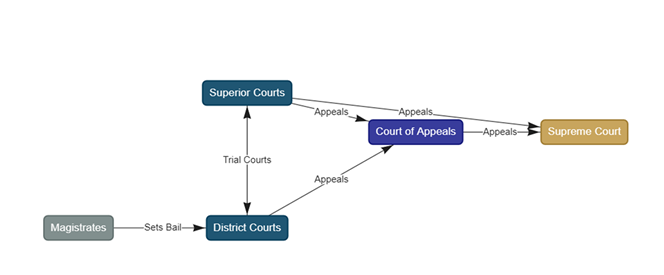
The graphic will give you a rough idea of how the criminal justice system in Guilford County is structured.
Superior Court
Superior Court has judicial districts, grouped into divisions, across the state. Guilford County is in the 2nd division. Superior Court is used for civil cases that involve more than $25,000 and for all felony criminal cases. This court also hears appeals from the District Court. Each court district has a Senior Resident Superior Court Judge who manages the administrative aspect of the court.
District Court
District Court handles cases related to civil, criminal, magistrate, and juvenile matters. Guilford County is part of the 24th Judicial District. Each administrative district is overseen by a Chief District Court Judge, who manages the court’s administration. Civil cases that are heard in District Court include divorce, child support, and custody matters, as well as lawsuits involving amounts under $25,000. Note that this is different from Small Claims Court, which is presided over by a Magistrate. District Court only addresses criminal cases that involve misdemeanors and infractions. Additionally, juvenile cases, including both dependency and delinquency matters, are also processed in District Court.
Magistrates
Magistrates are judicial officers in a division of the District Court. Magistrates have limited jurisdiction, but are authorized to hear small claims cases, certain eviction cases, and cases involving personal property recovery. Magistrates are also authorized to set bail and accept guilty pleas for minor misdemeanors and infractions.
Criminal Court
Criminal Court judges hear cases involving criminal offenses. District Court hears cases involving misdemeanors and infractions, while felony cases are heard in Superior Court. Appeals generally go through the Court of Appeals until it reaches the Supreme Court, if the Court chooses to hear the case. However, there are occasions when cases go from the Superior Court directly to the State Supreme Court, but this is rare.
Unpictured
There are both Business Courts and Administrative Courts that are not included here. We do not practice Business Law in this Firm. Administrative Court is outside the traditional Court System. It is used to resolve disputes between an individual and an agency. For example, the DMV and an individual during a license revocation.
There are two courthouses in Guilford County, North Carolina, which is unusual as most counties in the US only have one. This can make it confusing for clients to figure out where to report for their court date. The courthouse in High Point handles approximately one-third of all cases heard in the County. If you are unsure which courthouse you are to appear in, please refer to your citation, use the e-service here, call the clerk, or call your attorney.
Guilford County Courthouse
201 South Eugene St
Greensboro, NC 27401
(336) 412-7300
Guilford County Courthouse – High Point
505 East Green Drive
High Point, NC 27262
(336) 822-6700
Criminal Defense Attorney Anastasia Tramontozzi explains the 48-hour rule as it applies to an assault on female charges. Many people think that when they are charged with assault on a female there is a mandatory 48-hour cooling-off period, and they will spend that time in jail. This used to be true but is no longer the case. When charged with assault on a female, you have a Constitutional right to go before the first available judge within that 48-hour timeframe. So, if you’ve been charged with assault on a female, consult with one of our attorneys and bring your bond paperwork. Make sure your rights have been respected.
Our Greensboro law office is open Monday through Friday from 8:30 AM to 5:30 PM. If you need to meet outside of these hours, contact us in advance — evening consultations may be available by request.
Criminal Defense and Traffic Attorney Tyler Chriscoe, explains there are a few times when it is not acceptable to leave the scene after an accident. For instance, being scared or anxious about being in a wreck or not knowing what to do. While that can be a reasonable reason to leave, it is not actually validly lawful. Also, saying you had somewhere you needed to be will not go very far in a court of law either.
If you have been charged with leaving the scene of an accident it’s important to have an experienced lawyer on your side. Contact us to discuss your options.
A trusted civil law attorney discusses wrongful death lawsuits and addresses some common concerns people often have.
How long do I have to file a wrongful death lawsuit?
A wrongful death lawsuit must be filed within two years of the date of death.
Can you go to jail as the result of a wrongful death lawsuit?
No. A wrongful death lawsuit is a civil matter, not a criminal one. Charges may be taken out as the result of the death, but they won’t result from the civil lawsuit.
What does a wrongful death settlement look like?
The beneficiaries are entitled to lost wages, funeral expenses, accumulated medical bills, some punitive damages, and sometimes emotional distress.
How do you prove emotional distress in court?
Emotional distress is proven through a combination of testimony by those affected and advocacy by an experienced attorney.
If you’ve lost a loved one through someone else’s negligence and want to file a wrongful death lawsuit, call one of our attorneys today.
According to Criminal Defense and Traffic Attorney Tyler Chriscoe, sometimes it is legal to leave the scene of a crash but only in rare circumstances. For example, if staying would put you or anyone else in harm’s way. It is also alright to leave the scene should you require serious medical attention, not for a cut or bruise. But you can move their vehicle from the scene as long as you remain at the scene of the crash. Moving the vehicle should not cause more damage to the road.
These are civil lawsuits that arise when the death of a loved one is caused by the negligence of someone else.
What is the difference between wrongful death and survival action?
In a wrongful death suit, it is the decedent’s next of kin determined by statute that brings the lawsuit forward, usually this is a spouse, parent(s), or child(ren). In a survival action, it is the estate that brings the lawsuit.
Wrongful death and survival actions are complex and they arise at an extremely trying time, when people have just lost a loved one. If this has happened to you or someone you know, we’re here to help. Give us a call.
To schedule your consultation, call our Greensboro office directly or submit a form through our website. We’ll follow up to confirm your appointment and answer any immediate questions.
Criminal Defense Attorney Tyler Chriscoe explains why having insurance is important and why you may not actually be covered even when you have an active policy.
It’s the Law
In North Carolina, the law makes it a misdemeanor to operate a vehicle without insurance. The state has set a goal to protect its citizens and its roadways from damage caused by auto accidents. As a result, insurance is a requirement to make sure any damages are taken care of.
Personal vs Commercial Auto Policy
One size does NOT fit all. Insurance companies have personal auto policies and commercial auto policies. Each policy has a specific rating and covers certain types of activities that are particular to that policy. Many insurance companies will not provide coverage when a person is using their personal vehicle for business or commercial use.
Personal insurance policy is for personal use.
Commercial insurance policy is for when a vehicle is being used for business purposes. This includes food delivery, rideshare, farm work, construction work, and maid services.
Am I Covered if I work for a Rideshare App?
Working for a rideshare app or other app-based delivery services are relatively new and it has been difficult for insurance companies to keep up. Some of these app-based companies will provide coverage for their drivers. For example:
Uber will provide full coverage, both liability and collision, while their driver is en route to pick someone up, and while they are driving them to their destination. Uber will provide lesser coverage when the app is on but nobody is in their car. Finally, they provide no coverage when a person has the app off and is not driving for them. At that point, the driver’s personal auto policy would be in effect. Lyft has a similar policy.
Instacart’s user agreement tells its drivers that they will not provide any coverage and that drivers should call their personal auto insurance companies to make sure they have the right policy. Grubhub has a similar policy.
Turo, an app that allows a vehicle’s owner to rent their personal vehicle out to third parties, provides standard liability coverage to the third-party driver. The app allows the owner to choose collision and comprehensive coverage with different plans that are priced differently. This applies to other familiar activities like pizza delivery drivers. So, if you are driving for Domino’s or Papa John’s you are going to run into the same situation.
Bottom Line
If you’re using your personal vehicle for business use or if you’re driving for an app based company, it’s important that you do a few things.
Read very carefully the user agreement that is provided to you. The insurance details should be stated in that agreement.
Call your insurance agent or company and ask them if you are covered.
Your claim can be denied if your insurance company finds out you were using your personal vehicle for work. And if that happens, several things might happen as well.
You may have to pay out of pocket for damages that you cause in an accident.
It’s far less likely that a D.A. will dismiss charges if you don’t have an active insurance policy.
Insurance is a subject that most people don’t like to discuss but Criminal Defense Attorney Tyler Chriscoe explains its importance. Insurance can be expensive and most of the time you don’t actually see the benefit of having it.
It’s the Law
North Carolina law makes it a misdemeanor to operate a vehicle without insurance. The state has set a goal of protecting its citizens and the people using its roads from damages caused by accidents. Most people can’t pay out of pocket for damages they cause. Insurance is required to make sure that any damages caused by accidents are able to be covered.
How North Carolina’s Strict Negligence Law Can Affect Your Injury Claim
[00:00:00] If you’ve been injured in an accident in North Carolina, it’s crucial to understand a legal doctrine known as “contributory negligence.” Our state is one of the few that still adheres to this outdated and strict rule, which can significantly impact your ability to receive compensation.
What is Contributory Negligence?
[00:00:06] Contributory negligence means that if you are found to be even slightly at fault for the accident—even as little as one percent—the insurance company can legally deny your personal injury claim entirely.
[00:00:29] The video provides a stark example to illustrate this point: imagine you are legally crossing a street in a crosswalk and are hit by a drunk driver who runs a red light. If you were looking down at your phone at the moment of the accident, an insurance company could argue that your distraction makes you 1% at fault, giving them grounds to pay you nothing.
Critical First Steps After an Accident
[00:00:12] Because of this harsh rule, the actions you take immediately following a crash are vital for protecting your rights.
[00:00:15] Seek Medical Treatment: Your priority should always be your health. Seeking immediate medical care also creates an official record of any injuries you sustained.
[00:00:17] Contact an Attorney Immediately: It’s essential to speak with a lawyer before speaking with an insurance adjuster. Insurance companies will try to get a recorded statement from you quickly, hoping you’ll say something they can use to assign partial blame and deny your claim.
How an Attorney Can Protect You
[00:00:57] The most effective way to protect your claim from being denied due to contributory negligence is to have an experienced attorney handle all communications with the insurance company right from the start. [00:01:04] An attorney understands how to navigate this complex legal landscape and will advocate on your behalf to ensure you are treated fairly.
A Personal Injury Attorney discusses the kinds of damages car accident victims can expect to receive in North Carolina. These are:
Special damages include things like medical bills or lost wages. General damages include pain and suffering which insurance companies may not want to pay. While Punitive damages are designed to punish the defendant for some outrageous behavior, like drunk driving. If you’ve been injured in a car accident, be sure you’re getting all the damages you deserve. Call one of our Personal Injury Attorneys today!
Insurance companies are often viewed as prioritizing their own financial interests rather than the well-being of their policyholders. While they may not be inherently evil, their primary objective is to safeguard their bottom line. There are 3 top mistakes that can be made to decrease the amount of money you receive.
Placing trust in the adjuster assigned to their case. Adjusters are tasked with gathering information and asking questions, but their ultimate goal is to find grounds to deny the claim. Therefore, it is crucial not to naively assume that the adjuster has their best interests at heart.
Accepting a settlement offer that falls short of what the injured party truly deserves. Insurance companies have a clear understanding of the value of claims and often employ claims specialists or adjusters who may attempt to persuade claimants to settle for less. Without the knowledge of their claim’s true worth, individuals may unwittingly accept inadequate compensation.
Failing to negotiate with the insurance company. While the initial offer presented by the insurer may seem reasonable, it may not be their final and highest offer. Without the expertise of someone experienced in negotiating with insurance companies, claimants run the risk of settling for less than they deserve.
To avoid making these mistakes, it is advisable to consult a personal injury attorney before taking any actions that could jeopardize the claim or result in an inadequate settlement.
At our law firm, we believe in providing client-centered, results-driven representation. We take the time to listen to your concerns, answer your questions, and keep you informed at every stage of your case. Our attorneys have a proven track record of success in personal injury, criminal defense, and real estate law, and we’re committed to fighting for your rights and interests.
If you’ve been charged with a crime, our law firm provides skilled legal representation and guides you through the criminal justice system. We’ll carefully review the evidence against you, investigate your case, and develop a tailored defense strategy. Our attorneys will work tirelessly to protect your constitutional rights, negotiate with prosecutors, and fight for the best possible outcome in your case, whether that’s an acquittal, dismissal, or reduced charges.
If you’ve been injured in a car accident, it’s essential to seek medical attention right away, even if you don’t think your injuries are severe.
Document the accident scene, gather witness contact information, and refrain from admitting fault or giving statements to insurance companies. Contact our law firm as soon as possible so we can help protect your rights and pursue the compensation you deserve.
Our law firm focuses on personal injury law and criminal defense. Our experienced attorneys have a deep understanding of these practice areas and are committed to providing effective representation to each and every client. Whether you’ve been injured in an accident or are facing criminal charges, we have the knowledge and skills to help you achieve your legal goals.
Contact Us
Have questions or need legal guidance? Get in touch, our team is ready to help.